Basic Electronics Course in Kathmandu | Electronics Training Center
Are you looking to start your journey in the electronics field? Our Basic Electronics Course in Kathmandu is the perfect starting point for beginners who want to build a strong foundation in electronics and develop practical technical skills.
At Universal Electronics Institute, we provide industry-oriented training that focuses on both theory and hands-on practice. This course is specially designed for students, job seekers, and anyone interested in learning electronics from the ground up.
In today’s technology-driven world, understanding electronics is more important than ever. Our Basic Electronics Course is specially designed for beginners who want to build a strong foundation in electronics and gain practical skills that are essential for careers in mobile phone repair, computer- laptop repair, Television repair, Inverter-converter repair, robotics, and other technical fields.
This course introduces you to the core concepts of electronics in a simple and easy-to-understand manner. From learning about voltage, current, and resistance to understanding how electronic components like resistors, capacitors, diodes, and transistors work, you will gain both theoretical knowledge and hands-on experience.
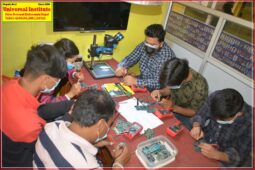
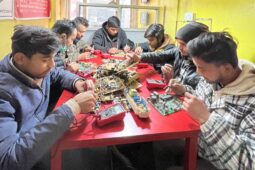
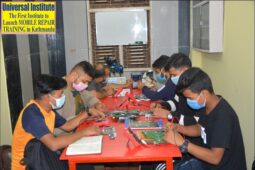
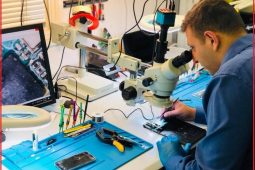
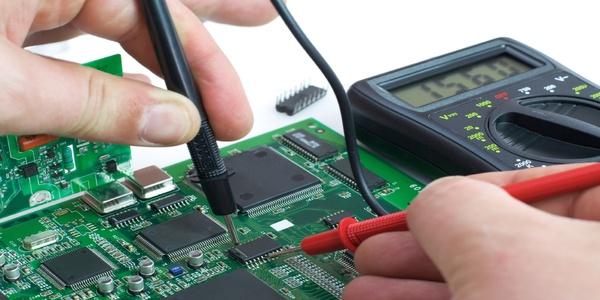
At our institute, we focus on practical-based training, ensuring that students not only understand concepts but also know how to apply them in real-world situations. You will get the opportunity to work with tools like multimeters, breadboards, and basic lab equipment while building simple circuits and troubleshooting common electronic problems.
Why Choose This Course:
This course is designed for individuals who are new to or have some experience in the electronics field. There are no prerequisite requirements, so students from non-technical backgrounds can easily join this Basic Electronics Repairing course. Beginner-friendly and easy-to-understand content
- 80% practical and hands-on training
- Experienced instructors and modern lab facilities
- Strong foundation for advanced technical courses
Take the first step toward your technical career with our Basic Electronics Course and unlock endless opportunities in the electronics and repair industry.
Target Group for Basic Electronics Course in Kathmandu
Our Basic Electronics Course in Kathmandu is designed for a wide range of learners who want to build a strong foundation in electronics and repair skills. This course is suitable for:
Who Can Join This Course?
- SEE School Leavers
Students who have completed SEE and want to start a technical career early.
- Technical College Students
Students looking to strengthen their practical knowledge alongside academic studies.
- Technicians
Working professionals who want to upgrade their skills in electronics and repair.
- Retirees
Individuals interested in learning new skills or starting a small repair business.
- Electronic Hobbyists
People passionate about DIY electronics projects and circuit building.
- Non-Technical Background Students
Anyone with no prior technical knowledge who wants to enter the electronics field.
- Job Seekers & Freelancers
Individuals looking for employment or self-employment opportunities in repair services.
Why Choose Universal Electronics Institute?
- The oldest among all institute in Kathmandu Valley, established in 2000AD;Over 25 years of experience.
- Certified & trusted by Nepal standard CTEVT and International standard ISO 9001:2015.
- Learn from The Expert Engineer with real-world industry experience.
- Live Practical Training: Theory 20% + Practical 80%
- 100% Job Placement for outstanding students.
- Free Certificate & Free PDF Book included with course enrollment.
- Learn with 100% practical, real-world experience.
- Hands-on practical training with modern tools and equipment
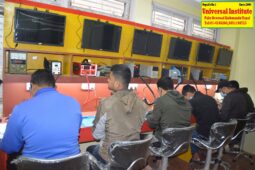
- Well-equipped lab with modern instruments (BGA Machine, Oscilloscope, Multimeter, etc.)
- Placement and self-employment support
- Lifetime technical support after course completion
- 3 days free demo classes
- Affordable course Fees
- Budget-friendly hostel facilities
What You Will Learn in This Course
- Basic electrical concepts (Voltage, Current, Resistance, Ohm’s Law)
- AC and DC fundamentals
- Identification and working of electronic components
- (Resistor, Capacitor, Diode, Transistor, IC)
- Use of measuring instruments like multimeter
- Circuit basics (Series, Parallel, Combination circuits)
- Breadboard and simple circuit building
- Soldering and desoldering techniques
- Basic troubleshooting and repair skills
Why Learn Electronics?
Electronics is one of the fastest-growing fields in research, application development, and commercialization. With high research funding, abundant job opportunities, and significant earning potential, a career in electronics offers both stability and growth.
Electronics is also everywhere in our daily lives, from smartphones and laptops to home appliances and industrial systems. While it can be challenging for practicing engineers to stay updated with the latest developments, the fundamental concepts of circuits and electronics taught in this course remain highly relevant and applicable, even as technology evolves.
Future Skills and Career Opportunities
The knowledge you gain from this course will enable you to communicate effectively with design engineers and technicians, helping you understand, design, and work with electronic systems. It will also prepare you to pursue any area of electronics that interests you in the future, including reading advanced textbooks, component datasheets, and technical manuals.
We aim to make learning electronics both interesting and enjoyable, giving you a strong foundation to explore more advanced topics and career opportunities in this ever-growing field.
Benefits of attending basic electronics courses
- Opportunity to work in the electronics industries.
- Reduce maintenance breakdown cost.
- Learn additional skill to lead you to a promotion.
- Start your own electronics repairing business.
- Pathway to further your studies.
- You will get to see some of the latest repair test equipment in the market.
Electronics Training Center in Kathmandu
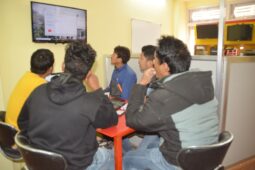
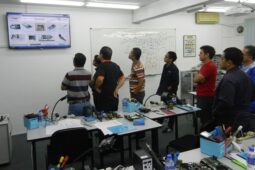
Universal Electronics Institute has been providing high-quality electronics training for many years, with the goal of developing skilled and expert technicians in the field of electronics. The institute emphasizes practical, hands-on training over purely theoretical knowledge, offering regular lab sessions to ensure students gain real-world experience.
Our training programs are designed to produce technicians who are ready to work in the industry. We also collaborate with experienced electronics professionals to guide and mentor our students. Trainees receive comprehensive support in electronic product design, testing, and repair, equipping them with the skills needed to build a successful career in electronics.
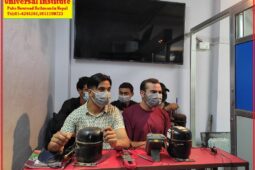
At Universal Electronics Institute, we believe in learning by doing. Our course includes 80% practical training, where students get hands-on experience with real tools and electronic circuits. This helps you gain confidence and real-world problem-solving skills.
Career Opportunities after This Course
After completing the Basic Electronics Course, you can:
- Move to advanced courses like mobile and laptop repair
- Start working as an electronics technician
- Begin your own repair or service business
- Build a strong foundation for engineering studies
The major equipment available in this basic electronics training center in Kathmandu are microprocessor trainer kit, microcontroller trainer kit, digital troubleshooting kit, microprocessor-based data acquisition kit, universal programmer and tester, DC regulated power supplies, multimeters, and RF&AF single generators. The institute is always fulfilling the requirements of the trainees who want to be the future technicians in the industry and has been established as one of the major electronics training centers in Kathmandu.
- Understand basic concepts like voltage, current, power, watt, heat and etc.
- Understand working principle of the most important electronic components.
- Identify schematic symbols and simple schematic diagrams
- Design basic circuits in a simulation environment
- Learn Electronics By Building Circuits From Circuit Diagrams
Beginner Electronics Training in Nepal
In this course, you will learn the fundamentals of electrical training, including electricity, conductors, insulators, voltage, current, resistance, potential difference (P.D.), and the relationship between voltage, current, and resistance. You will also understand the difference between AC and DC, the purpose of earthing, and the types of earthing.
By the end of this training, successful candidates will be equipped to take precautions against electrical hazards and handle basic electrical tasks safely. This basic electronics training is an integral part of all programs offered at Universal Electronics Institute, ensuring that every trainee gains essential electrical knowledge alongside electronics skills.
After completing the Basic Electronics Training Course, trainees will be able to tackle electronics-related problems confidently and are well-prepared for placements as technicians in various electronics industries. The courses are designed according to the latest technological advancements in electronics, ensuring that the training is relevant, up-to-date, and of high quality.
Our training center in Kathmandu is supported by expert instructors who share their extensive knowledge and industry experience with the trainees. They provide all the necessary study materials, including notes, slides, and practical lab exercises, ensuring a smooth and effective learning experience for every student.
Basic Electronics Course Near me
The institute is providing the basic electronics training and consultancy for electronic industry, selection of electronic equipment, facility design, process modification & design of electronic systems. This institute has been providing the basic electronics training in Nepal and many trainees are now working as technicians in the field of electronics.After the completion of the electronics training course in this institute, the certificates are provided to each and every trainee so that it will be easy for them to apply for the post of electronics technicians in many companies. The certified trainees are the qualified trainees for the job of electronics technicians in different companies.
Universal Institute conducts regular training programs and workshops on different topics for the betterment of the institute and its clients. This electronics training institute is now a leading institute in the field of electronics training and has proved to be the best institute for producing the expert technicians. So, enroll now in this electronics training institute if you like to work as electronics technicians.
We practice you, to be a professional in repairing all kind of electronics devices. This course teaches you step-by-step how to repair all kind of electronics devices. The advantage of our program is, you will be able to start your own repair and maintain electronic equipment repair center after completing of our course. The duties of an electronics repair technician revolve around working to repair electronic equipment in a variety of different settings. In addition to repair, in this career, you may work on the calibration of equipment, or you may perform tests to assess the performance of an electronic device and replace a component if necessary.
These professionals can work with a variety of equipment types, including electric vehicle and transportation equipment, commercial equipment, power stations,home appliance equipment and industrial equipment.
Basic Electronics and Digital Electronics Course
The digital electronic systems may be defined as the circuits that process information in a coded format. Their application domains are really large and nowadays one can find a digital electronic systems module in every electronic system. There are different ways to process information and numerous alternatives for implementing digital electronic systems, the election is not a trivial issue and it depends on the application and user requirements. The Digital Electronic Systems will provide students the assimilation of methods and strategies for analyzing and designing microcontroller based systems.This course is related to Basic Electronics (Analogue Electronics) and Digital Electronics .
Part one
1.Basic Electricity
a) Ohm’s Law
b) Kirchoff’s Laws
c) Faraday’s Laws of Induction
2.Anaiogue/Digital System (Basic Principle & Properties)
a) Binary, Decimal & Hexadecimal System &It’s Conversion
b) Analogue to Digital Conversion
c) Digital to Analogue Conversion
d) Different Types of Gates & Flip-Flop
e) De-Morgan’s theorem
3. Communication System
3.1. Propagation of Radio Wave
a) Direct wave
b) Guround wave
c) SKy wave
d) Relation Between lonosphere & HF
3.2. Broadcast Antenna System
a) Propagation, Polarization, Antenna gain , Impendence, directivity,etficiency, EMW
b) Different types of Antenna
c).Fading & Diversity
d) Transmission Lancs & Characteristics
3.3 Radio Receivers & Transmitters
a) AM/FM Transmite
b) Stages and it’s Functionns
3.4 Basic Principles of Wire & Wireless Communations systems
a) Transmission Method:-Wire/ cable, Fiber optics, Microwave
b) Transmission links:- HF,VHE,UHF wire less and Satellite Communations
c) Basic principle & stage of Television
3.5 B.E Sound System
a) Microphone
b) loudspeaker
4. Básic Electronics
a) Resistor, construction, types, characteristics, color code.
b) Capacitors, construction, types, characteristics, color code.
c) Semi conductor diodes:- PN Junction, depletion layer
forward & reverse bias, Zener diode &
lightemitting diode, varactor diodes, photo diodes, characteristics &
Applications
d) Rectifier circuits
e) Types of Transistors, working principles & it’ s Applications
f),Power transistor characteristics & Applications.
g),Photo transistor characteristics & Applications.
h) Oscillators circuit.
5. Computer Fundamentals
a) Basic computer Principles.
b) Input out put & memory organization .
c) Computer hard ware/ sottware.
d) computer network & system.
h) Internet & It’s applications .
6. Power Supply System
a) Main & stand by pe0wer suppiy system in broad casting.
b) Uninterrnuptile power Suppy system
c) Transtormer & lts types.
d) Battery,constructton & types
e) Principies of solar system.
Part Two
- Number System
- Boolean Algebra and Logic Gates
- Gate Level Minimization
- Combinational Logic Circuits
- Flip-Flops and Sequential Circuits
- Register and Counters
- Memory and Programmable Logic
Number System
- Program for Binary To Decimal Conversion
- Program for Decimal to Binary Conversion
- Program for decimal to octal conversion
- Program for octal to decimal conversion
- Program for hexadecimal to decimal
Algebra
- Properties of Boolean algebra
- Representation of Boolean Functions
- Canonical and Standard Form
- Functional Completeness
- Logic Gates
Logic Circuits :
- Half-Adder
- Half-Subtractor
- Half-Adder and Half-Subtractor using NAND NOR Gates
- Full-Adder
- Full Subtractor
- Code Converters – BCD(8421) to/from Excess-3
- Code Converters – Binary to/from Gray Code
- Code Converters – BCD to 7 Segment Decoder
- Parallel Adder & Parallel Subtractor
- Carry Look-Ahead Adder
- Magnitude Comparator
- BCD Adder
- Encoders and Decoders
- Encoder
- Binary Decoder
- Combinational circuits using Decoder
- Multiplexers
Register and Counters :
- Counters
- Design counter for given sequence
- n-bit Johnson Counter
- Amortized analysis for increment in counter
- Ripple Counter
- Digital Logic | Ring Counter
- Shift Registers
- Design 101 sequence detector
- Universal Shift Register
- RTL (Register Transfer Level) design vs Sequential logic design
- Verilog Data Types
Memory and Programmable Logic :
- Read-Only Memory (ROM) | Classification and Programming
- Programmable Logic Array
- Programming Array Logic
- RAM vs ROM
- Operational Amplifier (op-amp)
What is a Power Supply? | Power Electronics Training in Kathmandu
The power supply is the essential parts in every electronics system. Its circuit is used in various electrical & electronic devices. The main function of this power supply to change the electrical current from a source to the accurate voltage, frequency and current to supply the load. Sometimes, these power supplies can be named to as AC TO DC power converters. In this article, we look into the definition of a different types of power supplies and how they work.
- Variable Power Supply
Its power supplies are designed using transformers or adjustable autotransformers. Step down transformers convert AC-to-AC voltage levels. A transformer with multiple (primary n secondary)windings or taps may be used to design such power supply otherwise adjustable autotransformer can be used.
- Linear Regulated Power Supply
Its Linear regulated power supplies are AC-to-DC converter n regulator power supplies. These are the same as unregulated input power supplies except that they use a transistor circuit operating in an active or linear region in place of bleeding resistor.There are several voltage-regulator(oscillator)ICs available that have an active transistor circuit integrated within them.
- Adjustable Regulated Power Supplies
Adjustable voltages by using a variable resistor at the end-stage. The variable resistor can drop the output voltage to adjustable values. Such an adjustable power supply can then supply voltages in the range from 0 to 100 voltage regulated by the supply.
- SMPS Power Supply
A switch mode power supply (SMPS) is a type of power supply that uses Transister switching techniques, rather than standard linear methods to provide the required output voltage. The basic switching circuit converter consists of a power switching stage and a control circuit. The power switching stage performs the power conversion from the circuits input voltage to its output voltage which includes output filtering.
Module 1
Introduction to SMPS
1. Introduction to Switch Mode Power Supplies (SMPS)
2. Identifying Electronic Components in Different Types of SMPS .
3. Block Diagram of a Typical SMPS and How It Works
4. Easy Way To Understand The 11 Circuit Functions of SMPS With The Help Of Schematic Diagrams
5. Input Protection and EMI Filtering and Bridge CircuitCircuit
6. Start Up and Run DC Circuit
7. Oscillator Circuit
8. Secondary Output Voltage Circuit
9. Error Detection Circuit
10.Feedback Circuit
11. Protection Circuit
12. Power Factor Correction (PFC) Circuit
Module 2
Secrets of SMPS Troubleshooting Techniques
- Safety Guidelines
- Understand The Six Common Problems Found In SMPS
- No Power
- Low Output Voltage
- High Output Voltage
- Power Cycling/Pulsating/Blinking
- Power Shutdown
- Intermittent Power Problem
- How to Easily Perform Voltage Testing On SMPS Circuit
- How to Use Oscilloscope to Test SMPS Circuit Waveforms
- Find Out How Useful Is The Series Light Bulb Trick In SMPS
Module 3
Repairing Method
- Using the Blue Ring Tester Method
- Flickering Method
- Resistance Test Method
- Isolation Method
- Secondary Diode Removal Method
- Simple Way For Beginners To Troubleshoot And Repair Any
Course Overview – Fundamentals of Electronics
For beginners aiming to grasp the essentials of electronics, this course provides a solid understanding of voltage, current, resistance, Ohm’s Law, Kirchhoff’s Laws, and more. It helps learners develop an intuition for how electronic circuits behave, forming the foundation for further study and practical applications.
This course is ideal not only for those who want to understand the basics of electronics but also for learners who wish to explore key circuit theorems such as Superposition, Thevenin, and Norton. These fundamental concepts are crucial for analyzing and designing electronic circuits effectively.
Basic electronics course Kathmandu fees
The fee structure for basic electronics courses depends on the nature of the course, The course type, the level of difficulty, the kind of institution, duration of the training period, etc. However, the certification programs for this course fluctuates between Nrs: 13500 to Nrs:25,000 per package.
In Nepal, several types of basic electronics courses can be categorized based on the course format, institutions offering, course content, level of difficulty, etc. The course also offers different short-skill development courses at an affordable fee.
Course Duration: 30-45 Days
Training Time: 1.5 Hours Per day
Course Contain: Theory 20% + Practical 80%
Language of instruction: Nepali/Hindi /English
Group structure: 6 participants per group
New classes starts on: 1st, 10th and 20th(Every month)
Eligibility Criteria:
Individuals who meet the following criteria will be allowed to enter this Training program:
- Above 12 years of age
- Physically and mentally fit
- At Least Completed Class-8 or equivalent
Related Posts:
- Mobile Repair (Advance Chip Level)
- Computer/Laptop repair (Advance Chip Level)
- Advance Mobile Software (Full)
- TV(LCD/LED/Smart) Repair Course
- Basic Electronics & PWR Supply Course 45 days
- eMMC/UFS/Nand Training 30 days
- AC & Fridge Repair Training 60 days
- Washing Machine Repair Course-30 days
- Building Electricians(House wiring) 45 days
- CCTV Camera Opearting & Installation 45 days
- Home Appliances Repair Training 45 days
- Printer Repair (Dot-Matrix, Ink-Jak, Laser)
- Hobby Electronics Projects 45 days
- Drone Assembling Course 15 days
- Laptop Repair (Basic Card Level-1)